
Food safety in professional kitchens
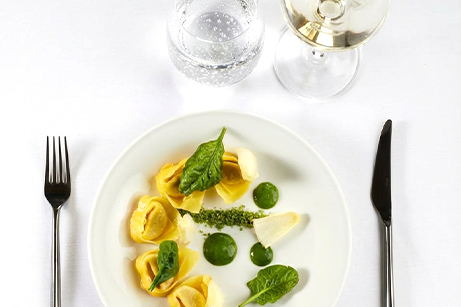
Do you really think that food safety in your professional kitchen ends with filling out the HACCP register?
That would be convenient.
But the truth is less reassuring: safety does not live in forms, but in the actions repeated every day, in correct storage temperatures, in organized workflows, in clean surfaces and in flawless washing.
In a professional kitchen, hygiene and safety cannot be left to goodwill, but must be part of an organized system with precise procedures, supported by a suitable environment and equipment that facilitate their execution.
What is the general situation?
Last year, in Europe, 5,691 foodborne outbreaks were reported, with consequences of varying severity and an increase in deaths. Lowering your guard is dangerous, much more than we are willing to admit.
Risk does not arise only from major mistakes but also from overlooked details:
A tray of sauce improperly blast chilled
Incorrect storage
An “almost” clean oven
A table that is difficult to clean in the corners
A dishwasher that does not maintain correct parameters or “washes” without detergent
The implications many underestimate
The first mistake is thinking that hygiene is only about “avoiding a complaint”.
It is not.
Hygiene and food safety mean avoiding waste, slowdowns, rework, stress in the kitchen brigade, negative reviews and a drop in how your business is perceived.
An excellent dish served on poorly washed tableware loses all its value.
A poorly stored semi-finished product compromises hours of preparation.
A kitchen that is difficult to clean turns the end of service into a race against time.
In modern food service, hygiene is reputation. It is operational continuity. It is the ability to standardize. It is part of your margin, not an additional cost.
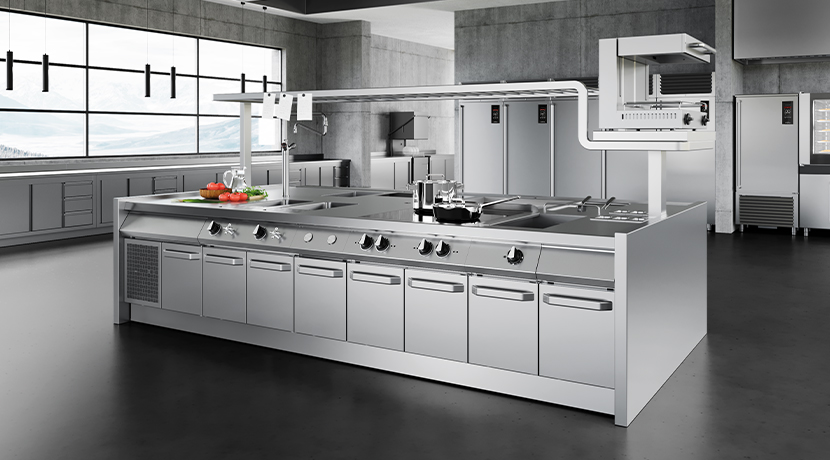
The TNK kitchen
TNK can help you protect your business with a kitchen that is easy to clean and technological solutions that simplify your work.
Imagine a professional kitchen that brings together refrigeration, cooking, ovens, preparation and washing in an ecosystem designed with dimensional compatibility, shared design and technology, to create kitchens that are more controllable, safer and more efficient.
This is a TNK kitchen.
Let’s look at some details that make the difference.
Let’s start with cold.
Coldline refrigeration is essential for food safety because it operates at the most critical points of the process: rapid blast chilling, freezing, safe thawing, pasteurization to eliminate pathogenic microorganisms and steam sanitation of the chamber.
All these work cycles are managed by tested programs that guarantee consistent results.
DEVOTE technology for VISION blast chillers reduces the use of the core probe, limiting the risk of bacterial cross contamination between different foods.
You achieve the best possible result, in the shortest possible time, in total safety.
And how is food stored?
You can monitor storage quality and continuity through Cosmo App, which promptly alerts you in case of anomalies. From Cosmo App you can also download HACCP reports for your kitchen and keep your records perfectly updated.
Convenient, right?
Let’s move on to cooking.
You may have a perfect recipe, but if the oven is not clean, the result will be poor.
The QUBI combi oven integrates a closed circuit automatic washing system, with single dose detergent and minimal water consumption, without rinse aid.
What does this mean in practice?
Fewer variables left to the operator, no waste, guaranteed results for a perfectly clean chamber at the end of each working day.
Then there is everything that many consider “secondary”, but it is not secondary at all.
Tuls, in the area of preparation, brings into the kitchen perfectly aligned worktops with Coldline refrigerated tables and upstands with internal rounding to facilitate cleaning of the work area.
Does it seem like a detail?
It is precisely these details that determine whether sanitation at the end of service will be fast and well executed or slow and poorly done.
And finally washing, one of the most underestimated and most decisive aspects.
Krupps, with Acquatech System technology, a combination of break tank, rinse pump and atmospheric boiler, applied to utensil washers, hood type dishwashers and undercounter dishwashers ensures washing that removes over 99% of bacteria from trays, cutlery, plates, glasses and cups.
The strength of TNK lies in its ability to let you work with a single logic: cold, cooking, ovens, surfaces and washing not as separate islands, but as parts of a more organized, more verifiable and safer process.
A team effort that delivers safety and hygiene.
Appointments and News
View all news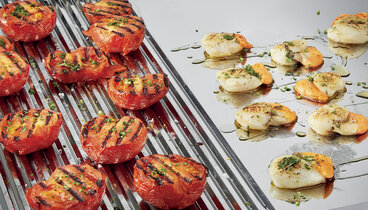
EROC Modular: the professional kitchen that saves...
Every professional kitchen wastes energy, before and during service. EROC reduces consumption by up...
Read more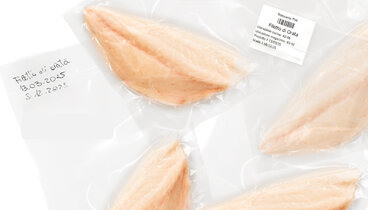
Earn €7,500 with Automatic Labels
What is the real cost of handwriting labels on bags containing prepared ingredients? Discover how...
Read more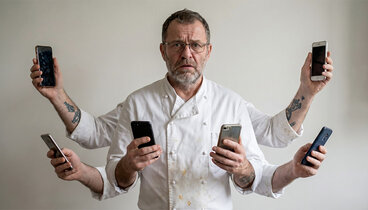
Do you use more than one App in the kitchen? You...
In professional kitchens there are many connected appliances: every product has its own App. But how...
Read more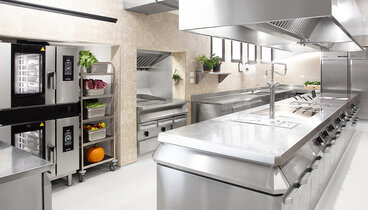
Does design matter in a professional kitchen?
Why do we still accept professional kitchens that look like they belong to the 1950s?
Read more
Food safety in professional kitchens
In professional kitchens, hygiene and food safety depend on many often underestimated factors....
Read more
How to reduce energy costs in professional...
Energy costs are one of the most critical factors affecting a restaurant’s profitability. Discover...
Read more

Krupps joins the TNK group
TNK strengthens its offering with Krupps, the Italian leader in professional washing equipment.
Read more
Horeca Expo
From November 16 to 19 – Stand 5243 – join us at Horeca Expo in Ghent, Belgium.
Read more



TheNiceKitchen gets stronger
We are pleased to announce the investment in TheNiceKitchen by 21 Invest.
Read more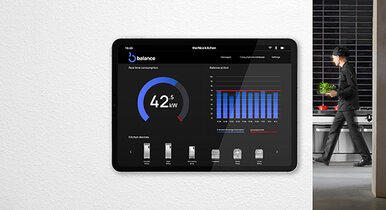
4 advantages of energy management with Balance
Experience shows that careful energy management is crucial for business. Our solution? It's Balance!
Read more
Small tricks for organising the kitchen
In a professional kitchen, organisation is crucial to ensure operational efficiency and maximise...
Read more
Which is the best oven?
There is no absolute best oven, and each technology must be chosen considering many aspects that...
Read more
Winning through teamwork
The best results are achieved when a team is close-knit even within a kitchen, discover the perfect...
Read more
The evolution is complete
The beginning of 2023 for Modular was full of novelties and changes: exciting projects took shape to...
Read more
How much do you make with a Coldline cabinet?
Choose energy-saving refrigerators and freezers, with Coldline you save 73% in energy costs.
Read more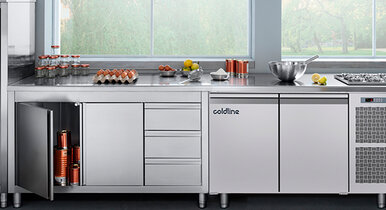
We design your successful kitchen
The success of a restaurant business is the sum of a mix of many factors that, properly balanced and...
Read more
Does quality food delivery exist?
Is there such a thing as quality food delivery? In the Nice kitchen our challenge is to prove that...
Read more
Roc: the best gas hobs
The gas cooker is something that every cook wants, handles with confidence and skill. Cooking and...
Read more
The connected and efficient kitchen
Ours is a hyper-connected reality: more and more devices are networked, exchanging data with each...
Read more
Delivery or service at the table?
Back to table service only or continue with home deliveries as well? A question that every...
Read more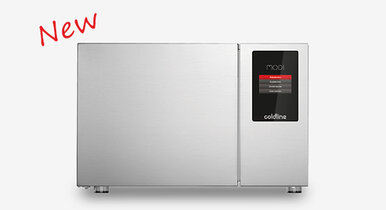
New Modi Active GN2/3 blast chiller
The Modi Active range of multifunction blast chillers expands with the new 3-trays GN2/3...
Read more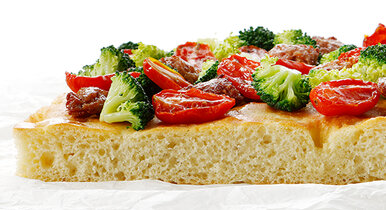
How to produce small and large leavened products
The technology to successfully organise, plan and manage small and large leavened products is called...
Read more